Do We Need a Renewables Policy?

Question: If an effective carbon tax or cap-and-trade policy is in place to limit greenhouse gas emissions, is there any point in having a separate policy to promote renewable energy sources?

I have read several times recently that the answer is ‘No’.  Carlo Stagnaro states, correctly, that most economists advocate technology-neutral policies such as a carbon tax or cap-and-trade as the most cost-efficient way to reduce emissions (1).  Supporters of policies to encourage renewables, he suggests, are either being naïve (in failing to realise that such policies increase costs) or advancing vested interests (of industries supplying renewable technologies).  John Whitehead puts the cost-efficiency point in a slightly different way: a suitable carbon tax or cap-and-trade policy will provide the necessary incentives to use renewables to the extent that they are an efficient means of emissions reduction, without the need for a separate renewables policy (2).  Robert Stavins pursues in more detail the economic consequences of combining cap-and-trade with a renewables policy, correctly identifying three effects (3):

  1. Any reductions in a company’s emissions due to the renewables policy will simply result in sales of emissions permits to other companies, enabling the latter to increase their emissions, so that total emissions will be the same as they would be with cap-and-trade alone.
  2. The renewables policy will undermine the equalisation of marginal abatement costs which would result from cap-and-trade alone and so increase total abatement costs (another version of the point made by Stagnaro and Whitehead).
  3. The renewables policy will reduce demand for emissions permits and so depress their price, and this will reduce the incentive for companies to invest in the development and installation of improved emissions-reduction technologies.

Let’s take a step back and review the objectives energy policy should address.  The list below would I suggest be widely acceptable: where energy policy becomes contentious is mainly in the choice of policy instruments to meet the objectives and in the priorities and trade-offs where objectives conflict.

  1. Short- and medium-term security of energy supply.  Key requirements are a) adequate electricity generating capacity, b) adequate infrastructure relating to energy for transport, and c) diversity of supply to reduce the risks from over-reliance on any one source of imported energy.
  2. Limiting energy costs to domestic and industrial users.  This includes a) limiting costs per unit of energy, and b) improving the effectiveness of energy use, eg via energy-efficient appliances and manufacturing techniques, and home insulation.
  3. Limiting negative externalities from energy supply and use.  Such externalities include a) greenhouse gas emissions contributing to climate change, b) local and regional air pollution, and c) risks associated with nuclear energy.
  4. Long-term sustainability of energy supply.  Key requirements are a) appropriate rates of depletion of finite sources, and b) improving technologies for exploiting both finite and renewable sources.

The problem I have with the positions of Stagnaro, Whitehead and Stavins is that their arguments only seem to address objectives 2 and 3a.  It also needs to be considered whether the encouragement of renewables might contribute to any of the other objectives.

It so happens that most renewable energy sources (hydro, solar, wind) do not emit greenhouse gases (or other atmospheric pollutants).  This is not entirely coincidence: if part of an energy source transfers to the atmosphere when it is used, that in itself indicates that the source is being depleted, and cannot be renewable unless what is transferred can be replaced (as with biofuels, which emit carbon when burnt but absorb it during growth).  Nevertheless, the essential characteristic of renewables is nothing to do with greenhouse gases or climate change: it is – to state the obvious – their renewability.  Either their use does not diminish their future availability, as with solar and wind, or they are replenished by natural processes, as with hydro via rainfall and biofuels via growth.  Although therefore renewables may have a contribution to make to the objective of reducing greenhouse gas emissions, the objective to which they most naturally relate is long-term sustainability of energy supply.

The fear that oil and other fossil fuels might one day become scarce used to loom large in debates on energy policy.  That fear has quite properly been eased by new technologies permitting the exploitation of previously inaccessible reserves of oil and gas, confounding earlier predictions of ‘peak oil’. Less rationally, the attention rightly given to climate change has perhaps tended to lower the profile of other scary visions of the future.  But the risk of future energy scarcity has not gone away.  A plausible scenario is that, in a few decades time, oil and gas might become so scarce as to be prohibitively expensive to most energy users. Future generations could be left to rely on some combination of coal (abundant but, unless carbon capture and storage can be made to work, highly polluting), nuclear (expensive and subject to well-known risks), and renewables.  Against that background, research and development in renewables can be seen as one of several prudent strategies that should be pursued to help improve the long-term sustainability of energy supply.

A market failure here that could justify a degree of subsidy is that the link between current research and profits that may be earned only after many decades may be subject to too much uncertainty to attract sufficient private investment. There could also be a need for policies to clarify or amend relevant property rights, both physical property associated with renewable installations, and intellectual property relating to new technologies (as with patents on new drugs, there may be a tension between providing incentives for development and allowing the results of development to be widely used).

For the long-term sustainability objective, what is important in respect of renewables is to find ways to improve efficiency and so reduce costs.  This is not best achieved by large-scale installation of current renewable technologies.  Admittedly, it is important that technologies are tested not only in ideal conditions but also in the range of real conditions in which they would have to operate if used on a large scale, and current technologies may offer scope for improvements via ‘learning by doing’. However, the main focus of a renewables policy with the aim of promoting long-term energy sustainability should be research and development in improved technologies for use if and when the need arises.

For some countries, there may also be a case for a policy encouraging investment in current renewable technologies to address the objective of short- and medium-term security of energy supply.  Consider this scenario.  A country has limited reserves of oil and gas.  It has large reserves of coal, but much of it is brown coal which, when burnt, can be even more polluting than ordinary bituminous coal.  Its public is strongly opposed to nuclear energy. It has opportunties to generate wind and solar energy within its territory, albeit at a cost which is too high to attract much private investment.  As a consequence it is heavily reliant on imported coal, oil and gas, of which a high proportion is from countries that are considered potentially unreliable.  Thus there is a risk of a serious energy shortage if, say, a severe winter were to coincide with an international crisis. Many of its energy users, if they had the option of paying a higher price for their energy in return for greater security of supply, would be willing to do so (just as they voluntarily pay for security in other aspects of their lives via insurance premiums and pension contributions). However, although the country’s electricity companies compete on price, the electricity is delivered through a single grid, and therefore it would be impracticable for any company to make a credible offer of secure supply in the event of a future shortage. Hence the workings of the energy market do not channel user demand for greater security in a way which creates incentives for electricity generators to become less reliant on imports.  There could then be a case for a policy encouraging domestic investment in current renewable technologies to address the failure of the market to respond to demand for greater energy security.

There are, therefore, at least two potentially legitimate arguments for policies to encourage the development or use of renewables.  How exactly such policies should be targeted, what policy instruments are most suitable, and the scale of any subsidy, are further issues.  I am certainly not offering a defence of the particular renewables policies of the European Union and its member countries.  What I am saying is that to reject any sort of renewables policy on grounds that have regard only to cost and greenhouse gas emissions would be a simplistic response to the complexities of energy supply.

References

1.  Stagnaro C (Institute of Economic Affairs) (13 Jan 2014) EU renewables target protects favoured industries at the expense of consumers  http://www.iea.org.uk/blog/eu-renewables-target-protects-favoured-industries-at-the-expense-of-consumers

2. Whitehead J (23 Jan 2014) No pain no gain?  http://www.env-econ.net/2014/01/europe-facing-economic-pain-may-ease-climate-rules-nytimescom.html

3. Stavins R (18 Jan 2014) Will Europe Scrap its Renewables Target? That Would Be Good News for the Economy and for the Environment  http://www.robertstavinsblog.org/2014/01/18/will-europe-scrap-its-renewables-target-that-would-be-good-news-for-the-economy-and-for-the-environment/

Posted in Climate change, Energy | Tagged , , , , , , | Leave a comment

Groundwater Extraction and Sea-Level Rise

The global consequences of groundwater extraction have received less attention than many other environmental issues.  Here are the main points, in Question and Answer form.

Does groundwater extraction contribute to sea-level rise?
Yes, at a global level.  A basic principle of hydrology is that water may change its state (liquid, ice or vapour) or location, but is never lost.  Water extracted from groundwater aquifers must go somewhere.  Its initial destination will depend on its use. When used in agriculture, some will enter the atmosphere as water vapour via transpiration by crops and evaporation from soil, and some will enter rivers via run-off from soil.  When used for domestic or industrial purposes, much of the resulting wastewater will again enter rivers.  But water vapour in the atmosphere condenses to form clouds and fall as rain, much of which falls on the sea, and rivers flow to the sea.  It is true that water also passes in the opposite direction, by evaporation from the surface of the sea into the atmosphere, where it may be carried by wind and contribute to rainfall on land and percolate through the soil into aquifers.  But that is a natural process that occurs anyway.  Groundwater extraction can in some circumstances result in a net transfer of water from aquifers to the sea, contributing to sea-level rise.

What circumstances determine whether extraction from a particular aquifer will contribute to sea-level rise?
Aquifers differ both in the extent to which they are recharged by rainfall and local water flows, and in the extent to which they discharge water naturally via springs, seeps or underground flows.  Where an aquifer is recharged at a fairly stable rate, it is a renewable resource and if the rate of extraction matches the rate of recharge there is unlikely to be any effect on sea level.  Some of the water extracted will still reach the sea, but because the water table in the aquifer will be below its natural level, there will probably be an offsetting reduction in natural discharge, some of which would otherwise also have reached the sea via the atmosphere or rivers.  Where however an aquifer in an arid region receives little or no recharge, extraction will have a cumulative effect in lowering the water table, and the transfer of water to the sea will not be offset by any other effect.  Between these extremes are intermediate cases in which extraction is partly offset by natural recharge.  The key indicator of an aquifer’s contribution to sea-level rise is therefore its rate of depletion, not its rate of extraction.

How can rates of groundwater depletion be measured?
One approach (the volumetric approach) involves estimating the change in groundwater volume of water over time.  Volume changes can be inferred from changes in water tables, or from changes in mass as measured by its gravitational pull.  A limitation of this approach is that it requires a separate measurement for each aquifer.  Unless measurements are available for all large aquifers around the world, estimates of global depletion must be extrapolated, using questionable assumptions, from those measurements that are available.  An alternative (the flux-based approach) involves estimating the various water flows into and out of aquifers.  Estimates of groundwater extraction at country level are available from the International Groundwater Resources Assessment Centre (1).  A limitation of this approach is that inflows, and natural outflows, are difficult to measure accurately.  Where rates of abstraction and recharge are both high, moreover, net depletion will be calculated as a difference between numbers that are both subject to uncertainty.  Neither of these approaches can be expected to give more than very rough estimates of total global depletion.

What is the current rate of global groundwater depletion?
Using a primarily flux-based approach, Wada et al estimated global depletion for the year 2000 at 204 cu km (cubic kilometres) (2).  Using a volumetric approach, Konikow estimated average annual global depletion at 102 cu km during 1991-2000 and 145 cu km during 2001-2008 (3).  Taking a figure between these estimates, a best estimate of depletion for the year 2000 might be 150 cu km.  Consideration then needs to be given to growth in depletion to date.  Konikow’s estimates suggest annual growth of about 4% which, if continued, would imply depletion in 2013 of very roughly 250 cu km.

What is the current annual sea-level rise attributable to groundwater extraction?
Very roughly 0.7 mm (millimetres).  This figure is obtained by dividing estimated annual groundwater depletion – 250 cu km – by the surface area of the world’s oceans and seas –  360,000,000 sq km.

How does this compare with total annual sea level rise and the contributions of other factors?
It represents just under a quarter of total annual sea-level rise which is estimated by the Intergovernmental Panel on Climate Change at 3.2 mm (this is an average for the period 1993-2010).  Most of the remainder is due to climate change, comprising 1.5 mm for melting of glaciers and polar ice, and 1.1 mm for thermal expansion of seawater (4).

In economic terms, does the contribution of groundwater extraction to sea-level rise represent an externality?
Yes.  Cumulative sea-level rise imposes costs of protection or migration on people whose homes or livelihoods are at or only slightly above sea level.  Those who extract groundwater do not have regard to those costs.

Is there a case for policy intervention to mitigate sea-level rise by discouraging groundwater extraction?
Probably not, unless the rate of extraction becomes much higher.  The situation parallels, albeit on a less dramatic scale, that of carbon emissions and climate change.  Just as a carbon tax is widely advocated as an efficient method of reducing carbon emissions, so a per unit tax on extraction of non-renewable groundwater would in principle discourage extraction for uses with a private value per unit less than the tax.  However, the practical difficulties would be considerable.  Many countries already have policies to control extraction with the aim of sustainable management of their groundwater resources, but implementation and enforcement have often been difficult (5).  Much groundwater extraction is by small farms with individual tubewells, so the costs of monitoring extraction and collecting a tax would be high.  Estimating the costs of sea level rise attributable to groundwater extraction to inform setting of a tax rate would be contentious.  Equity also needs to be considered.  Those extracting groundwater (eg in India and Pakistan) include many poor farmers (6), while those potentially affected by sea level rise include not only poor people on low-lying island nations in the Pacific and elsewhere, but also inhabitants of coastal cities in developed countries (eg Miami, New Orleans) (7).  This is not to say that governments should do nothing.  To the extent that sea-level rise is due to anthropogenic climate change, policies such as carbon trading schemes or carbon taxation contribute to its mitigation, and this is part of their justification (although mitigation of climatic effects on human living conditions and agriculture may be more important justifications).  There may also be justification for policies to help people adapt to sea-level rise, such as assistance with the costs of moving or, for those on low-lying islands, emigration.  But the case for addressing sea-level rise by discouraging groundwater extraction is not strong.

Notes & references

  1. International Groundwater Resources Assessment Centre Information System  http://www.un-igrac.org/publications/119

2.  Wada Y, van Beek L, Weiland F, Chao B, Wu Y & Bierkens M (2012) Past and future contributions of global groundwater depletion to sea-level rise  Geophysical Research Letters 39 L09402 p 2 of 6    http://chinawaterrisk.org/wp-content/uploads/2012/07/Past-and-Future-Contribution-of-Global-Groundwater-Depletion-to-Sea-level-Rise.pdf

3.  Konikow L F (2011) Contribution of global groundwater depletion since 1900 to sea-level rise Geophysical Research Letters 38 L17401 p 4 of 5   http://water.usgs.gov/nrp/proj.bib/Publications/2011/konikow_2011b.pdf

  1. Church J, Clark P et al (2013) Working Group 1 Contribution to the IPCC Fifth Assessment Report, Climate Change 2013: The Physical Science Basis Chapter 13 Sea Level Change p 16  http://www.climatechange2013.org/images/uploads/WGIAR5_WGI-12Doc2b_FinalDraft_Chapter13.pdf

5.  Comprehensive Assessment of Water Management in Agriculture 2007  Water for Food, Water for Life: A Comprehensive Assessment of Water Management in Agriculture  London: Earthscan, and Colombo: International Water Management Institute  pp 416-7

6.  Comprehensive Assessment, as above pp 407-9

7.  Global Green USA  Sea Level Rise: The Risk, The Facts
http://www.globalgreen.org/articles/global/95

Posted in Water | Tagged , , , , , | Leave a comment

Cities and the Environment

Environmental economics can be an important tool in urban planning.  It can also inform discussion of the place of cities in a sustainable world.

When I first studied environmental economics, cities seemed to make only the occasional guest appearance in support of other topics.  In the context of pollution control, cities featured as locations at which polluters and polluted might be close together.  In land economics, they played the role of central points from which rents fell and transport costs rose with increasing distance.  In the economics of water, cities competed with farmers for water from surrounding regions.  Cities also provided the setting for hedonic price studies estimating the value of environmental amenities from their impact on house prices.   But that was about all.  The existence and characteristics of cities were not seen as part of the subject matter of environmental economics.

More recently, I have come to see issues relating to cities as a key topic within environmental economics.  Consider some of the trade-offs involved in urban planning.  Given cities with the same population, one can occupy less land than another if it has less industry or green space, or more of its infrastructure underground, or taller residential buildings, or less floor space per resident.  The outcome of such trade-offs has many environmental implications.  A more spacious city impinges more on surrounding areas, with greater loss of the ecosystem services of farmland, woodland or wetlands.  By spreading residents and employers more thinly, it also raises average intra-city journey distances, increasing energy use for transport and associated pollutant emissions.  A more spatially concentrated city on the other hand may have any or all of the following:  more crowded living conditions; more tower blocks and subways; less separation between residential and industrial districts; less of the ecosystem services provided by urban green space and trees; and more pollution ‘hot-spots’.

Finding the best trade-offs for a particular city in particular circumstances requires input from various specialisms.  Environmental economics can contribute in two main ways.  Firstly, it offers non-market valuation techniques that can put approximate monetary values on many of the environmental costs and benefits associated with cities.  Monetary value can then be a common unit for comparing different kinds of environmental costs and benefits with each other and with market goods.  Where planning decisions are informed by cost-benefit analyses, non-market valuation techniques enable environmental consequences to be given due weight.

Secondly, environmental economics can help evaluate policies to address not only actual but also potential environmental externalities.  Discussions of the classic example of smoke from a factory causing harm to neighbouring residents often assume that both factory and residents are already present (1).  Suppose however that the factory is at the proposal stage. In that case the best outcome is most likely to be obtained if consideration of whether to permit the factory to be built is combined with consideration of how, if it is built, the resulting smoke problem can best be addressed.  Environmental economics offers methods to assess whether the best approach would be direct regulation, or a market-based instrument such as a per-unit tax on emissions.  The planning decision can then be informed by comparison of the costs and benefits of refusing permission and those of granting permission but also applying the best emissions reduction approach.  Similar considerations apply to proposals with positive externalities.  Provision of green space within a private housing development, for example, might offer environmental benefits in any case, but environmental economics could help identify the best approach to maximise the benefits for the wider community.

A fundamental issue is whether the very existence of large cities is advantageous in terms of long-term environmental sustainability.  For the question to make sense it is important to define the counterfactual.  Some may have a romantic vision of a simpler, rural life.   But the interesting comparison, to my mind, is with a world with the same population and living standards as now, and the same prospects of raising living standards in future, but with the population spread much more evenly over the habitable land area, with many more villages and towns and perhaps small cities, but no large conurbations.  So the villages and towns would have their industries and public services, and few of their inhabitants would work in agriculture.  They would be plugged in, via the internet, to the world’s knowledge, cultures, social networks and trading opportunities.  Their people would travel – on business, to visit family and friends, or for holidays – but with the difference that their destinations would never be large cities.

A world in which both people and industries were more evenly dispersed would have some important advantages for sustainability.  Although international trade in food would continue, domestically-produced food could be grown closer on average to where people live, reducing food miles and use of energy for food transport.  The water requirements of smaller communities could often be met from nearby sources, reducing the costs of transporting water.  Local air pollution from industrial sources would be less likely to reach dangerous levels.  Avoidance of the urban heat island effect (2) would be a benefit in many regions, reducing the need to use energy for air-conditioning.  The risk of very large numbers of people being affected by a single natural disaster (as when a city is hit by an earthquake) would be reduced.

A dispersed world would also have disadvantages.  There would be no room for large wilderness areas such as national parks, important providers of ecosystem services.  Although the risk of a natural disaster affecting ten million people would be less, the frequency of disasters affecting ten thousand people would be much higher.  Industries subject to economies of scale in production would not fit readily into such a world.  But the biggest problem could be transport.  Although the costs of transporting some food and water might be lower, those of transporting people would probably be much higher.  With people concentrated in cities, many travellers make similar inter-city journeys, enabling planes and trains to be filled with passengers and reducing the cost per person.  By contrast, journeys between dispersed communities would be much more varied, with much less scope for cost reduction, and as a consequence higher overall energy consumption and pollutant emissions.  With factories also dispersed, the same would apply to the transport of raw materials and of intermediate and finished manufactured goods.

My sense is that at present the disadvantages of the dispersed world outweigh its advantages.  But this could change.  One factor could be climate change.  In his Climatopolis, Matthew Kahn has shown how cities might adapt to a hotter climate (3).  But where rising general temperatures aggravate the effects of urban heat islands, people may increasingly prefer not to live in cities.  Another factor could be technological development.  The internet has already facilitated the remote delivery of many kinds of services, and weakened the argument that city-based business clusters are an essential ingredient in economic growth.  Continuing improvements in vehicle fuel-efficiency could reduce the energy needs of transport in a dispersed world.  More speculatively, the need to transport manufactured goods could be greatly reduced if the technology of digital manufacturing were to develop to a point at which it offered an economic method of producing many kinds of goods close to the consumer from local materials.

Even if we were to conclude that the dispersed model was or will become the more sustainable, we could not simply abandon the huge investments that have been made in building cities.   Given the long life of much infrastructure and housing development, however, it is important to consider whether proposed developments take us toward or away from the sort of model that is likely to be most sustainable in 50 or 100 years’ time.  China, for example, a country which already has many large cities, some with severe air pollution (4), proposes further major urbanization over the next decade.  Michael Pettis has an interesting discussion of the short-term macroeconomic implications of this urbanization (5).  But whether such rapid urbanization, in China and other countries, tends to promote or hinder long-term sustainability is I think an open question.

Notes and References

  1. See for example Baumol W J & Oates W E (2nd edn 1988) The Theory of Environmental Policy  Cambridge University Press  p 21

  2. NASA (2010) Satellites Pinpoint Drivers of Urban Heat Islands in the Northeast  http://www.nasa.gov/topics/earth/features/heat-island-sprawl.html

  3. Kahn M E (2010) Climatopolis: How Our Cities will Thrive in the Hotter Future Basic Books  288pp

  4. CNN International Edition (19/9/2013) China to shame worst-polluting cities over and over in push for green action  http://edition.cnn.com/2013/09/19/business/china-shame-worst-air-polluting-cities/index.html

  5. Pettis M (16/8/2013) The urbanization fallacy  http://blog.mpettis.com/2013/08/the-urbanization-fallacy/#comments

Posted in Cities | Tagged , , , , | Leave a comment

The Oil Demand Debate

Improved fuel efficiency and substitution of natural gas will restrain world oil demand over the next decade.  But will these effects be enough to offset increasing demand from emerging economies? This important debate could be sharpened by clearer economic language.

A conventional view of world oil demand is that it will continue to grow for many years  as countries such as China and India enjoy rapid growth, creating huge new demands for the transport of people and goods.  But this is challenged in a recent report by Citi Research entitled ‘Global Oil Demand Growth – The End Is Nigh’.

Based on research by its automobile equity team, Citi Research forecasts annual fuel efficiency improvements for new vehicles of 2.5% per annum as manufacturers respond to standards coming into effect in many countries and to high oil prices (1).  That may not seem a lot, but it implies a halving of fuel consumption per mile in just 28 years.  It also forecasts significant substitution of natural gas for oil in transport, petrochemicals and (in countries with oil-fired power stations) electricity generation (2).  In the US, substitution is already occurring due to cheap shale gas.  In other countries it is expected to accelerate from 2016 with the completion of many LNG (liquefied natural gas) export projects (3).  The report also shows that these trends apply to emerging as well as developed economies.  China, for example, has introduced vehicle fuel economy standards which will take effect in 2015, and is establishing an infrastructure network for refuelling natural gas vehicles (4).

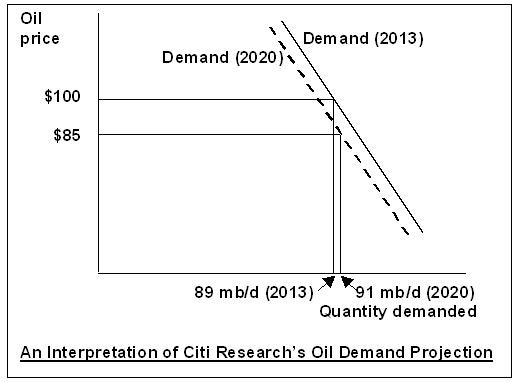
Allowing for these factors, Citi Research projects world oil demand as plateauing at about 91 mb/d (million barrels per day) from 2018, only slightly above its 2012 level of 89 mb/d (5).  But here I have a problem.  I was brought up, economically speaking, to distinguish between a change in demand, meaning a shift of the whole demand curve, and a change in quantity demanded, meaning a movement along the demand curve associated with a change in price.  When I read a prediction that demand will be so many million barrels per day, I wonder what this means and what is being assumed.

Focussing on the oil demand curve and making the usual ceteris paribus assumption, I would say that improved fuel efficiency will shift the whole curve, reducing quantity demanded at any particular price.   Increased supply of natural gas and increased capacity to use it as a transport fuel will shift the curve in the same direction.  On the other hand, rising incomes in emerging economies will shift the curve in the opposite direction, increasing quantity demanded at any particular price, even if the cars bought by the growing middle classes and the vehicles that supply their goods are highly fuel-efficient.  So I was initially inclined to interpret the report as implying that these opposing forces affecting the demand curve are now almost in balance, and will reach a balance from around 2018.Oil Demand Diagram

But then I noticed that Citi Research also predict a fall in oil prices from their current $100 per barrel to $80 – 90 by 2020 (6).  A levelling-off of quantity demanded at a time when price is falling implies a fall in demand – a shift of the demand curve to the left (see diagram).  This assumes, as most studies suggest, that oil demand is moderately price-elastic (7).  If the price and quantity predictions are taken together, therefore, the implication is even more striking than the report’s title suggests: a fall in world oil demand over the period to 2020.  In other words, the forces tending to reduce oil demand will more than offset those tending to increase it.

This is perhaps to read too much into Citi Research’s report.  Unfortunately, it does not state whether the demand projection takes account of the projected price fall or is based on constant prices.  Moreover, the chart showing this projection was reproduced in a recent feature in The Economist (8), where it was no doubt much more widely seen, but remained subject to the same lack of clarity.

This debate over future oil demand is important, not least because substitution of natural gas for oil (and coal) is one of the most practicable ways of reducing carbon emissions and mitigating climate change – a point highlighted by Dieter Helm in his book The Carbon Crunch (9).  It is perhaps slightly unfair of me to single out Citi Research for a looseness in economic terminology of which many others have been guilty.  But it would certainly make for a sharper debate if participants would indicate clearly what they mean when they predict changes in demand.

Notes and References

  1. Citi Research (2013) Global Oil Demand Growth – The End Is Nigh  p 2

  2. Citi Research as above p 1

  3. Citi Research as above p 5

  4. Citi Research as above pp 6 & 9

  5. Citi Research as above p 2 Figure 1

  6. Citi Research as above p 1

  7. Hamilton J D 2008) Understanding Crude Oil Prices p 34 Table 3  http://dss.ucsd.edu/~jhamilto/understand_oil.pdf

8.   The Economist (August 3-9 2013) p 21 Table 2

9.  Helm D (2012)  The Carbon Crunch  Yale University Press  pp 195-6

Posted in Energy, Minerals | Tagged , , , , , | Leave a comment