Green Space: An Important Use of Urban Land

How much green space does London have?  Does it have more or less than other major cities?  These simple-looking questions are not so easy to answer.

I enjoy walking in parks and woodland, and over the years have visited many of the green spaces in and around London.  I have pleasant memories of Regent’s Park, Hyde Park, Battersea Park, Greenwich Park, Hampstead Heath, Wimbledon Common, Richmond Park, Farthing Down, Ashtead Common and Epping Forest – to name just a few.  Personally, I am very content that London has a lot of green space.  But an economist is bound to ask whether the amount is optimal.   What is the best balance between green space and other land uses?

I hope to address these questions in a future post.  But first it would be helpful to know how much green space London has, and how it compares in this respect with other large cities.  This is not as simple as it may seem. The City of London Corporation has recently published a report ‘Green Spaces: the Benefits for London’ (1).  Its accompanying press release states as follows (2):

“London benefits greatly from being the greenest major city in Europe … [Its] provision of 35,000 acres of public parks, woodlands and gardens mean that nearly 40% of its surface area is made up of publicly accessible green space. The next major city green space provider in Europe is Berlin, with 14.4% of green surface area.”

There is some dubious logic here.  35,000 acres is only about 9% of London’s total area, not nearly 40% (3).  Furthermore, the “greenest major city in Europe” claim is found in the report itself to be based on a comparison with just three cities (Paris, Berlin and Istanbul) (4).

The basis of the ‘nearly 40%’ figure above is the UK government’s generalized land use database (GLUD) (5) which classifies London’s land use as follows:

Domestic (buildings and gardens)     33%
Non-domestic buildings    5%
Roads, railways and paths    14%
Green space    38%
Water    3%
Other    7%

Green space is defined here to include all vegetated areas larger than 5 square metres other than domestic gardens, regardless of accessibility to the public (6).

So London’s publicly accessible parks, woodlands and gardens amount to 9% of its area. To get to 38% you have to include all of the following:

  • private parks open only to local residents, found in some richer parts of London;
  • grassed areas used for sports, eg golf courses, football pitches, cricket grounds;
  • allotments;
  • wasteland with vegetation;
  • farmland, found in the boroughs of Bromley, Havering and Hillingdon where the boundary of the Greater London area extends beyond the built-up area.

What about the comparison with Berlin?  The definition corresponding to the figure of 14.4% is unclear.  But an official German source gives an analysis of land use in Berlin which, including recreational land, farmland, forest and woodland, implies total green space of 34% (7), not much less than London’s 38%.  Moreover, although percentage of green space within a city’s area is a useful statistic, it is not the only relevant basis for comparison.  Also useful is the area of green space per person.  Compared to London, Berlin has both a smaller total area and a much smaller population.  Hence, while London’s 38% represents 78 square metres per person, Berlin’s 34% represents 88 square metres per person (8).

The green space percentages for 9 other major cities quoted in the report range from 47% for Singapore to just 1.5% for Istanbul (9).  Given the above findings relating to London and Berlin, I wonder whether these percentages are on a fully comparable basis, although recent protests in Istanbul have highlighted the shortage of green space in that city.

The report identifies many benefits of London’s green space, grouped under four categories (10):

  1. environmental: cooling, drainage, improving water and air quality, carbon capture, and support for biodiversity;
  2. physical, mental health and well-being; space for exercise, air quality (again), and stress relief;
  3. social: enhanced cognitive and motor skills and socialisation for children via play space, greater social interaction and community cohesion via inclusive, free space;
  4. economic: cost savings to government via several of the above benefits, increasing property values for homeowners, attracting tourists, and possibly (the evidence is limited) attracting businesses to locate.
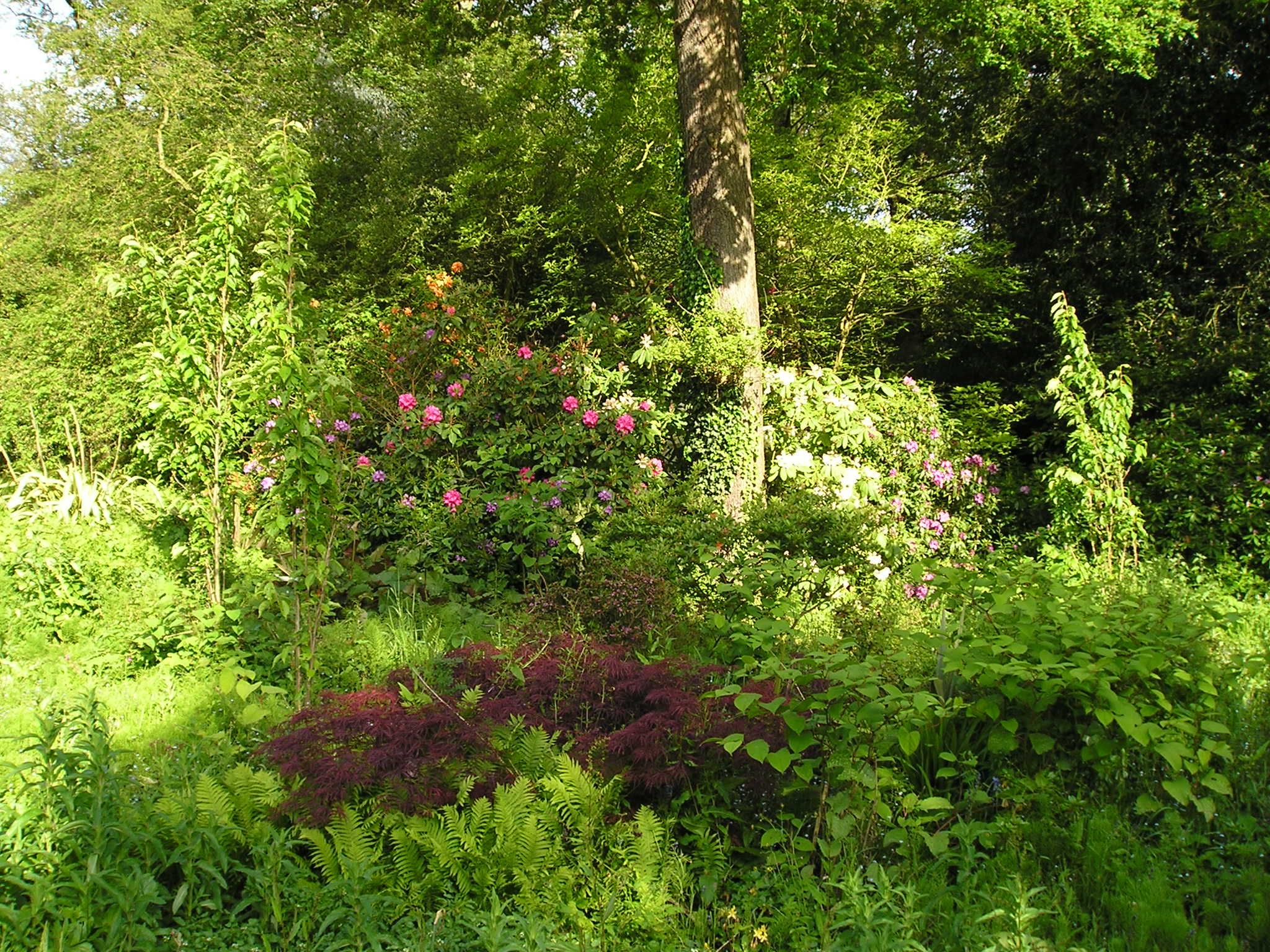
Biodiversity in Cannizaro Park, south-west London

Biodiversity in Cannizaro Park, south-west London

It is no shortcoming of this list that it could apply to almost any large city.  However, it is one-sided in focussing on benefits and ignoring costs.  Consideration might have been given in the physical category to effects on hay-fever sufferers, and in the social category to the risks of crime in green space (some may recall the Rachel Nickell murder on Wimbledon Common in 1992 (11)).  In the economic category, higher property values benefit homeowners, but disadvantage those seeking to become homeowners.  Then there is the most important cost of all: the opportunity cost of the land – its value in its most valuable alternative use.

Not all these benefits apply to all types of green space.  Broadly, the physical and social benefits only apply to publicly accessible green space.  The environmental benefits apply to all green space, although the extent to which they apply to particular sites depends on the local geography, type of vegetative cover, and other variables.

Finally, although carbon capture by green space in London is certainly a benefit, it is just a very small contribution to carbon capture by vegetation worldwide, helping to mitigate the rise in the global level of atmospheric CO2 and so to moderate climate change.  It does not provide a benefit specific to London.

Notes and References

1. City of London Corporation & BOP Consulting (2013)  Green Spaces: the Benefits for London  http://www.cityoflondon.gov.uk/business/economic-research-and-information/research-publications/Pages/Green-Spaces-.aspx

2. City of London Corporation, Press Release 9 July 2013   http://www.cityoflondon.gov.uk/about-the-city/who-we-are/media-centre/news-releases/2013/Pages/london-is-europe%E2%80%99s-greenest-major-city0710-5217.aspx

3.  1 acre = 4,840 square yards = 4,047 square metres = 0.4047 hectares.  So 35,000 acres = c 14,200 hectares.  Greater London’s area is c. 1,600 square kilometres = 160,000 hectares.  Hence 35,000 acres represents 14,200 / 160,000 = c 9% of the total area.

4.  See Table 2 on p 2 of 1 above.  Only 4 of the cities listed are in Europe.

5.  Greater London Authority  Generalised Land Use Database 2005  http://data.london.gov.uk/datafiles/environment/land-use-glud-borough.xls   (Although originally a UK government initiative, this data appears to be no longer available on UK government websites.)

6.  Centre for Research on Environment Society and Health (CRESH)  http://cresh.org.uk/cresh-themes/green-spaces-and-health/ward-level-green-space-estimates/

7.  State Statistical Institute Berlin-Brandenburg  Berlin in Figures 2010 p 2  https://www.statistik-berlin-brandenburg.de/produkte/faltblatt_brochure/berlin_in_Zahlen_engl.pdf

8.  London: 38% of total area 1,600 square kilometres = 608 square kilometres = 608,000,000 square metres, divided by population 7,825,000 = 78 square metres per person.  Berlin: 34% of total area 892 square kilometres = 303 square kilometres = 303,000,000 square metres, divided by population 3,443,000 = 88 square metres per person.

9.  As 4 above.

10.  1 above, p 6 ff

  1. Wikipedia  Murder of Rachel Nickell  http://en.wikipedia.org/wiki/Murder_of_Rachel_Nickell
Posted in Cities, Environment (general), Recreation | Tagged , , , | 1 Comment

Of Fish, Fishers and Consumers

The reform of the EU Common Fisheries Policy announced on 30 May is an important step towards sustainable and more profitable fishing.  But the interests of the consumer merit more explicit recognition.

A stated aim of the reform is “to restore and maintain fish stocks above levels that can produce the MSY (maximum sustainable yield)” (1).  The choice of “above” rather than “at” is intriguing.  Bioeconomic models of the relationships between fish stocks, fishing effort and the value of fish caught do indeed suggest a sustainable optimum in which fish stocks are above the levels associated with MSY.

The simplest model (sometimes called the Gordon-Schaefer model) leads to the following well-known diagram (2) in which the curve shows the relation between revenue and effort in steady state (RE), that is, with catch equalling natural growth of the fish stock.  In steady state, fish stocks are higher when effort is less, since higher stocks imply greater catch and revenue per unit of effort.

Fishery Diagram 1

E(MSY) is the level of effort that maximizes catch and revenue.  The cost of effort line is drawn with cost below revenue at E(MSY), reflecting the fact that fishing in EU waters is profitable in aggregate despite overfishing (excessive effort) in some regions (3).  E(OA) is the open access equilibrium, a situation in which unregulated fishers pursue their individual interests, raising effort so high that reduced fish stocks and higher costs reduce profits to zero.  E(MP) is the level of effort that maximizes profit, where marginal revenue – the slope of the revenue-effort curve – equals marginal cost.  Current fishing effort in EU waters appears to be between E(MSY) and E(OA), and the reform rightly seeks to rebuild fish stocks by reducing effort.

Like all simple models, this simplifies reality in many ways.  Fish come in many species, with different rates of growth and migratory characteristics, and different market prices.  Fishing involves varied techniques of differing capital intensity, and fishing effort is not randomly applied.  Fishing costs may fluctuate with changes in costs of inputs such as fuel.  Intuitively, it seems reasonable to suppose that a model which averages such differences within a few simple measures can still tell us something useful.  However, one limitation which is unhelpful in considering EU policy is that the model treats the price of fish as given.

Total demand for fish caught in EU waters can be expected to be downward-sloping since  such fish represents about 40% of all fish consumed in the EU, the remainder comprising imports (50%) and aquaculture within  the EU (10%) (4).  Competition from imports, though important, is limited by consumer preferences for particular species and by tariff and non-tariff barriers.  At the same time demand can be expected to be fairly price-elastic because of this competition, and because meat and other protein sources are to some extent substitutes for fish.  It follows that changes in effort at steady state will be associated not only with changes in catch but also with changes in the price at which the catch can be sold.

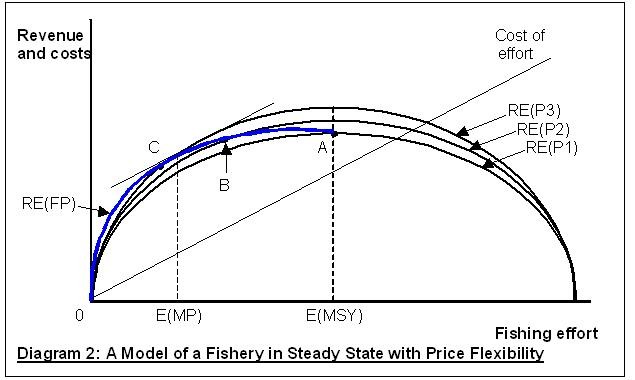
Given price flexibility, there is a different steady-state revenue effort curve corresponding to each possible unit price.  The diagram below shows such curves for prices P1, P2 and P3, where P1 is the price at which quantity demanded equals MSY.  Since these curves never cross, each revenue-effort combination is on only one such curve and so associated with a unique price.

Fishery Diagram 2

With effort at E(MSY), the steady state is at point A on RE(P1).  Now consider the effect of progressively lower levels of effort.  With less effort, catch is lower, so prices are higher and fish stocks are larger.  At a certain level of effort, well below E(MSY) if demand is fairly elastic, price is P2, with steady state at B.  At an even lower level of effort, price is P3 with steady state at C.  The blue curve joins revenue-effort combinations at which demand at the associated price equals the steady state catch for the effort (the portion of the curve to the right of A is not shown).  It could perhaps be called the flexible-price steady state revenue-effort curve (RE(FP)).

E(MP), effort to maximize profit, is where the slope of the blue curve equals marginal cost.  But overall social welfare also depends on how different levels of effort and therefore catch and price impact on consumers.  Consumer surplus is maximized at E(MSY), since price in steady state cannot be less than that at MSY.  A measure of overall social welfare is the sum of profit and consumer surplus.  Socially optimal fishing effort can be shown to be between E(MP) and E(MSY).  One way to see this (5) is to note that, as effort is increased from E(MP) to E(MSY), the fall in profit is initially slow, because marginal revenue is close to marginal cost in the vicinity of E(MP), but becomes much faster towards E(MSY) as marginal revenue falls.  The increase in consumer surplus, however, shows the opposite pattern, increasing more rapidly initially where the increase in catch and therefore the fall in price is faster.

The economic case for restricting fishing effort below the level that maximizes sustainable yield, therefore, is not that this is what is necessary to maximize fishing profits.  Restricting effort permits larger fish stocks, increases catch per unit of effort, lowers costs, and raises fishing profits.  However, it also changes the balance of economic benefit between fishers and consumers.  Fishing in the EU is currently far from the profit-maximizing position.  But as in other industries, measures to restrict output could be used to exploit consumers.  It could help to build support for its reform if the EU were to state that the objective of restricting effort is to increase fish stocks and maximize social welfare, not to maximize the profits of the fishing industry.

Addendum (14/6/2014)

The mathematics of the above flexible price model is set out in this post.

Notes and References

1. EU Committee on Fisheries (Press Release 30/5/2103) European Parliament secures sustainable fisheries policy  p 1   http://www.europarl.europa.eu/committees/en/pech/press-releases.html#menuzone

2. See for example Hartwick J M & Olewiler N D (2nd edn 1998) The Economics of Natural Resource Use  p 114

3. European Commission (30/5/2013) Consultation on Fishing Opportunities for 2014: see p 2 re overfishing and p 6 re profitability   http://europa.eu/rapid/press-release_IP-13-487_en.htm?lang=en

4. FAO Fishery and Aquacultute Statistics 2010: these approximate percentages may be inferred from information on pp xvii, 8, 27 & 52  http://www.fao.org/docrep/015/ba0058t/ba0058t.pdf

5. The proposition that social welfare is maximized at a level of effort between E(MP) and E(MSY) can also be derived algebraically if, in addition to other standard assumptions, it is assumed that that the demand curve is downward-sloping and linear.

Posted in Fisheries | Tagged , , , , , , | Leave a comment

Managing Natural Capital in England

England has established a Natural Capital Committee to advise the government on the efficient and sustainable management of the country’s natural wealth.  In April 2013 the committee published its first report and invited comments.  Below is an abbreviated version of my submission.

I am writing in reponse to the invitation to provide feedback on the Natural Capital Committee’s  The State of Natural Capital Report (1).  I welcome the report and would like to comment on Recommendations 1, 2, 9 and 12.  In addition to the report itself I refer below to the UNU-IDHP UNEP Inclusive Wealth Report 2012 (IWR) (2).

Recommendation 1 (pp 6-7)
“The development of a framework within which to define and measure natural capital…”

This is sensible and indeed an essential foundation for many of the report’s other recommendations.

Assets lying deep underground – minerals of various kinds, and groundwater – receive limited attention in the report. For example there are 46 mentions of fish, fisheries, etc and 3 of coal.  There is much reference to ‘sustainable use’, an important concept but one which makes most sense in relation to biological and other renewable assets.  For non-renewable assets such as minerals, no rate of use is sustainable indefinitely.  Instead, key questions are whether the rate of depletion has regard to the needs of both present and future generations, and whether profits from extraction are invested to provide for the future.

England’s mineral energy sources – not only those currently recoverable but also those which may become recoverable through technological advance – are a key part of its natural capital.  Alternative energy sources – imported fossil fuels, nuclear power, hydroelectricity, wind and solar power – all have their risks and limitations.

Groundwater aquifers may be either renewable or non-renewable, depending on rainfall and geological conditions.  Groundwater in England is a major source of domestic water supply.  It is also used extensively by industry, and to irrigate cropland in drier parts of the country. The availability of groundwater indirectly benefits ecosystems in drier areas by relieving pressures for over-extraction from surface water bodies.

Recommendation 2 (p 7)
“The development of a ‘risk register’ for natural capital assets ….”

Such a risk register could be extremely valuable. Its merits include:

  1. Focussing on specific risks rather than abstractions such as ‘genuine savings’ or ‘inclusive wealth’ would by-pass some of the theoretical arguments associated with the latter.  A risk register could more easily gain credibility with politicians and the public.
  2. As a list, a risk register would be robust in the sense that an error or contentious assumption in respect of one risk would not ‘infect’ all the other risks in the register.  This is in contrast to economic aggregates, where an error in the valuation of one asset has the potential to ‘infect’ any aggregates in which it is included.
  3. A risk register, while not determining policy, would be a clear step towards development of policies on natural capital.
  4. Listing risks together in a register should encourage a sense of proportion and facilitate informed judgments on priorities where it is not practicable to address all risks at once.

A risk register should include risks of all kinds relating to natural assets, eg unsustainable use of renewable assets, over-optimal depletion of non-renewable assets, and degradation of assets.  It should also include realistic assessments of ‘upside risks’ associated with possible technical progress, eg whether carbon capture and storage (CCS) can be made to work on an economic scale, which would reduce climate change risk and increase the value of England’s large coal reserves.

The time dimension is important in assessing risks.  For many risks, eg those associated with climate change, the probability of an outcome of given severity is likely to increase with the length of time considered.  For any asset class, the register should include not only the most immediate risks but also potentially more serious longer term risks.

Recommendation 9 (p 9)
“In addition to conventional indicators, the Government develops measures of economic growth, net of the depreciation of natural and other forms of capital as well as more comprehensive metrics of saving and inclusive wealth.”

That any new measures should be additional to conventional indicators is important.  One reason is the limited progress internationally in the development of economic performance indicators reflecting depreciation of natural capital. Another is the continuing usefulness, despite their limitations, of conventional indicators.

Even within conventional economics, it is accepted that multiple indicators are needed to assess a country’s economic performance: not only GDP and its variants such as gross national product and net national income, but also capital stock, employment, inflation, the balance of payments, and income distribution.  Adding to this list some indicators that have regard to natural capital would be an evolutionary change which politicians and the public could in time come to accept.

By contrast, dropping GDP altogether would be undesirable. Despite its limitations, it serves important purposes in the management of an economy and as a long-term performance indicator. International comparisons show strong correlations between GDP and indicators of development such as life expectancy and literacy.

The Inclusive Wealth Report represents one of the most sophisticated attempts to date to bring natural capital within the framework of macroeconomic statistics.  However, it has some important limitations:

  1. Its estimates of inclusive wealth explictly include at most 5 (and for some countries including the UK only 3) classes of natural assets. Ecosystem services, for example, are not explicitly included.  Part of their value is reflected in the price of agricultural land (IWR p 146), a significant point if the sole aim is to monitor trends in a single figure representing total inclusive wealth.  However, for practical purposes it is also important to monitor trends in the values of particular asset classes.  One would like to know the trend in the value of ecosystem services, not just to know that part of it is reflected in another figure.
  2. The discount rate applied to future benefits appears to be 5% per annum (IWR p 283), implying that benefits in 15 years time are valued at only half as much as benefits today.  While some such assumption is hard to avoid, the results are very sensitive to the rate chosen, and any particular rate is likely to be contentious.
  3. The methodology of inclusive wealth is focused on prices which – whether market prices or shadow prices – relate to marginal units of assets (IWR p 18).  There is no mention of the concept of consumer surplus, which reflects the value of intra-marginal units of a good.  This is surprising since in the academic literature on valuation of non-market assets using revealed and stated preference techniques it is standard practice to measure asset values in terms of consumer surplus (or its Hicksian variants). The value to a consumer of the first few units of a good is often much higher than the value of the marginal unit, especially for goods essential to life such as food and water.  If the value of the ecosystem services on which food and water supplies depend were measured in a way that reflected the value to consumers of intra-marginal units, it is likely that the overall value of natural capital relative to other forms of capital would be much larger than the inclusive wealth figures suggest.  This is not to say that the inclusive wealth approach is wrong: it may be that different value concepts are useful for different purposes.

These limitations  suggest that there remains a long way to go before we have reliable, well understood and timely measures of the value of natural capital or overall wealth.  Successful implementation of Recommendation 9 will be a long-term project.

Recommendation 12 (p 9)
“The Government reviews the extent to which natural capital is being effectively priced, in particular examining the scope for reducing perverse subsidies.….”

Underlying mis-pricing is often an absence or attenuation of property rights.  The report makes no mention of property rights.  However, it is widely recognized that the difficulty of addressing climate change is closely connected to the fact that there are no property rights over the atmosphere.  Less dramatic, though still important, is the precise definition of rights associated with land ownership.  One reason for the rapid exploitation of shale gas in the US is that landowners often have rights over the assets below their land, and therefore a strong incentive to allow their exploitation.  Whether or not the UK should be exploiting its shale gas is contentious, but the example illustrates how a country’s definition of property rights can have a major impact on its management of its natural capital.  Where there are judged to be serious risks to a particular class of natural asset, it should always be considered whether property rights, or their absence, are among the causes.

Notes and References

  1. Natural Capital Committee (2013), The State of Natural Capital: Towards a Framework for Measurement and Valuation. http://www.defra.gov.uk/naturalcapitalcommittee/files/State-of-Natural-Capital-Report-2013.pdf

  2. United Nations University International Human Dimensions Programme (UNU-IDHP) and United Nations Environment Programme (UNEP) (2012), Inclusive Wealth Report 2012. Measuring progress toward sustainability. Cambridge: Cambridge University Press. http://www.unep.org/pdf/IWR_2012.pdf

Posted in Energy, Environment (general), Minerals | Tagged , , , , , , | Leave a comment

The Economics of Urban Rainwater

Lack of natural drainage in urban environments can lead to flooding and pollution.   Economics can help find appropriate solutions.

There is a furore in Maryland, USA, where many residents will soon have to pay a “stormwater management fee” based on the area of impervious surface on and around their homes (roofs, driveways, car parks, etc).  The measure is prompted by the condition of Chesapeake Bay, an important fishery and recreational resource that has been degraded by polluted rainwater run-off.  Critics have dubbed it a “rain tax”: the first word is perhaps misleading, but as for the second, if it looks like a tax and smells like a tax … For a flavour of the debate, here is a news item (1), a case for (2), and one against (3).

Let’s look at the issue of urban rainwater run-off from an economic perspective.  Run-off from A’s property to B’s can affect B’s welfare.  There is an externality, with the following characteristics:

  1. The amount and pollutedness of water running off from A’s land to B’s depend partly on variables outside A’s control.  But A can affect it in several ways.  One is by having impervious surfaces, which prevent natural drainage and, less obviously, result in pollution of run-off by deposits of airborne pollutants originating from cars and power stations (4).
  2. What matters for B’s welfare is the aggregate effect of the water arriving from all sources. Small amounts of water from each of many sources can combine to flood B’s land.
  3. Downstream, run-off from many sources may come together in large flows with the characteristics of a “public bad”.  If B’s land is flooded then his same-level neighbours’ will be too, regardless of some having interfered with their natural drainage less than others.
  4. Eventually, run-off may arrive at a large water body such as a lake or river estuary.  Here the aggregation of pollutants brought by water from many sources may, as in Chesapeake Bay, degrade the natural ecosystem with adverse consequences for users.

What policy instruments can address such a complex externality?  A network of stormwater sewers funded by charges to households can significantly reduce the risk of flooding.  Economies of scale in network provision point to local monopoly provision, with regulation to ensure standards and prevent over-charging.  Given the externality and “public bad” characteristics of run-off, individual households should be required to pay and to connect to the network except in unusual circumstances.  Without compulsion, many upstream households at little risk of flooding would opt out, rendering the network less effective in preventing flooding and/or increasing costs to other households.

Here in London, a household which can show that none of its rainwater enters the public sewer network can obtain a “surface water drainage rebate”, meaning that it need not pay the stormwater drainage element within its overall water services charge (5).  The justice of this is dubious, since the sewer network may still protect such a household from flooding by run-off from higher ground, and if its rainwater runs instead into a natural stream, it could contribute to downstream flooding.  To allow such a rebate is to treat the sewer network simply as a service to those households whose rainwater it carries away.  Instead, it should be regarded as a practical response to a complex externality.

An unintended effect of a sewer network is to transport any pollutants carried by the rainwater into the water body in which it discharges (I ignore here situations in which combined sewers carry both rainwater and domestic sewage to a treatment plant prior to discharge).  For serious pollutants such as hazardous chemicals, a combination of regulation and liability law is warranted to prevent their entry to the network.  What can be difficult is to find an appropriate policy for low-level pollutants such as nitrogen from garden fertilizers and atmospheric deposition which can cause harm when channelled in large quantities into a water body.  This problem appears to be particularly challenging in the circumstances of Chesapeake Bay, which has a population of 16 million within its watershed and only a narrow outlet to the open sea, limiting dispersion of its pollutants (6).

A key question is whether in an economic sense the water body is over-polluted.  The relevant test, in principle, is whether the damage to the water body from a marginal unit of pollutant exceeds the benefit from the marginal activity resulting in that unit of pollutant.   Damage here should include both economic loss to users of the water body and loss of non-market values relating to recreation, ecosystem services and biodiversity. For a pollutant that may cause harm over many years, damage should be calculated on a present value basis, with allowance for its rate of decay or dispersion and an appropriate rate of time preference.  This test is not easy to apply.  It requires: reliable scientific knowledge quantifying the links between activity and pollutant and between pollutant and harm; reliable estimates of non-market values; and identification of marginal activity where there are many sources of pollutant involving different types of commercial and household activity.

Where a water body is assessed as over-polluted, an appropriate policy objective in most cases will be a reduction in the amount of pollutant entering the water body, bringing about a progressive reduction in the stock of pollutant it contains and eventually reaching a position in which, so far as can be assessed, marginal damage roughly equals marginal benefit.  In some cases this may usefully be accompanied by the sort of restoration suggested by the term “clean-up”, involving the application of physical, chemical or biological processes to the water body.  It is unlikely to be economically optimal to reduce the stock of pollutant as fast as possible.  Where polluting activities are subject to diminishing returns or diminishing marginal utility, a given reduction in pollutant will reduce their benefits by less overall if spread over several years than if concentrated in one year (compare having a 20% smaller car park for five years with having no car park at all for one year). An optimal restoration path will balance the benefit saved by spreading the reduction in pollutant against the extra damage from a longer period of over-pollution (7).

Taxes are likely to be the most suitable policy instruments to reduce the scale of the polluting activities.  Regulation would be too inflexible and heavy-handed for matters such as the area of a household’s driveway.  As a market-based instrument, a tax on areas of impervious surface would allow a household to have a large driveway and pay the associated tax if it wished.  Another household for which a driveway was of less value given its lifestyle might choose a smaller one or none at all.  Alternative market-based instruments are marketable permits and subsidies.  The former are probably too complicated to use at the level of individual households.  Subsidies could have a role to play in supporting activities which reduce run-off, such as soakaways and tree cultivation, and could also work in conjunction with taxes (see this post), but are unlikely to be the main policy instrument.

However, taxes do have disadvantages.  The extent to which a given rate of tax will reduce polluting activity will not be known.  Achieving a desired reduction may require a trial-and-error approach to rate-setting with consequent uncertainty for taxpayers.  Taxes needs to be suitably targeted, and for some polluting activities a suitable target may not be available.  Provided that the science linking impervious surfaces to pollution is well-established, area of impervious surface is an appropriate target: relevant to the objective;  easy to measure; and hard to conceal.  It is difficult however to identify a suitable target relating to garden fertilizers.  A tax on quantity used would be impossible to enforce, and a tax on sales, limited to the relevant watershed, could be easily avoided by buying elsewhere.  This creates a problem.  Considering an activity in isolation, it may seem that an economically appropriate rate of tax per unit of activity should roughly equal (with allowance for the needs of any restoration path) the damage resulting from the pollutant associated with a marginal unit of activity.  However, if some types of polluting activity are difficult to tax at all, there could be (although the economic assessment would be quite complex)  a “second-best” case for a higher rate of tax on those that can be taxed.  Addressing polluting activities that are difficult to tax through education and product labelling could perhaps mitigate this sort of situation.

One point about a tax is clear.  An economic case for a tax designed to reduce polluting activity need make no reference to how the tax revenue would be used.  Using it to pay for schools or reduce a deficit would not prevent a well-designed tax from being an effective policy to reduce pollution. There should be no presumption that revenue from a tax on current polluting activity should be spent on cleaning up the effects of past pollution.  Any expenditure on clean-up activity or other pollution-related purposes should be justified in cost-benefit terms in comparison with alternative uses of the funds.

Notes and References

  1. The Baltimore Sun, 29 March 2013  Howard council approves new stormwater fee  http://www.baltimoresun.com/news/maryland/howard/ellicott-city/ph-council-stormwater-fee-20130328,0,7762933.story

  2. The Washington Times 23/4/13 Chesmar J Chesapeake Bay Foundation on Maryland Rain Tax: Time to own up http://www.washingtontimes.com/news/2013/apr/23/chesapeake-bay-foundation-maryland-rain-tax-time-o/

  3. Gazette.Net Maryland Community News Online, 5 April 2013  Lee B The’Rain Tax’ http://www.gazette.net/article/20130405/NEWS/130409397/-1/the-x2018-rain-tax-x2019&template=gazette

  4. US Environmental Protection Agency 2007 Development Growth Outpacing Progress in Watershed Efforts to Restore the Chesapeake Bay Report No. 2007-P-00031 p 5   http://www.epa.gov/oig/reports/2007/20070910-2007-P-00031.pdf

  5. Thames Water  Apply for a surface water drainage rebate  https://secure.thameswater.co.uk/dynamic/cps/rde/xchg/corp/hs.xsl/15757.htm

  6. US EPA, as above p 2

  7. The dynamic stock pollution model applied in this paragraph is set out in Perman R, Ma Y, McGilvray J & Common M 3rd edn 2003  Natural Resource and Environmental Economics  pp 548-553

Posted in Cities, Pollution, Water | Tagged , , , , , , , , , , | Leave a comment