Reducing Pollution with a Combined Tax and Subsidy

Commonly discussed options for reducing pollution at minimum economic cost are taxes, subsidies and marketable permits.  A combined tax and subsidy should be added to this list.

Suppose a government wants to reduce an industry’s emissions of a pollutant to a target level.  A ‘command and control’ approach with emissions targets for individual firms can be effective in reducing emissions, but is unlikely to do so at minimum economic cost (1).

Economists therefore recommend instead market-based instruments.  These include a tax per unit of emissions, a subsidy per unit of emissions avoided (relative to a suitable benchmark), and marketable emissions permits.   These instruments minimize costs because each firm, in minimizing its private costs, will reduce its emissions to the point at which its marginal abatement costs equal the rate of tax or subsidy, or the market price of permits (2).

Each instrument has disadvantages.  A tax imposes costs on firms, which may be driven out of the industry, and indirectly on their customers.  Marketable permits increase firms’ risks because future permit prices are unknown, and generate transaction costs in the operation of the permit market.

Subsidies bear closer examination.  A per unit subsidy is equivalent to a lump sum subsidy less a per unit tax at the same rate, the implicit lump sum equalling the benchmark emissions level multiplied by the per unit rate (3).  High benchmarks, perhaps reflecting actual emissions in a baseline period, imply large lump sums with gains for most firms.  A subsidy based on a high benchmark is therefore a significant cost to the government and can, perversely, increase emissions by attracting more firms into the industry (4).

The size of the lump sum element, however, will not affect a firm’s decisions on abatement levels, only its decisions whether to operate in the industry at all (5).  Why not, therefore, combine a per unit tax with smaller lump sum subsidies based on lower benchmarks?  This would mean that excess emissions – those above a firm’s benchmark – would bear a per unit tax, while if a firm’s emissions were below its benchmark, the difference would qualify for a subsidy at the same rate per unit.

According to the Tinbergen Rule, achieving n policy objectives requires n policy variables.  In favourable circumstances, a combined tax and subsidy could achieve three objectives:
a) a target for an industry’s emissions;
b) minimization of the industry’s abatement costs;
c) financial neutrality for the industry and the government.
This is how it would work.  The choice of a per unit tax on emissions – rather than a ‘command and control’ approach – ensures cost minimization.  The rate of tax is chosen to induce sufficient abatement to reduce emissions to the target.  Financial neutrality is then achieved by the choice of the benchmarks determining the lump sum subsidies to combine with the per unit tax.

The benchmarks could be set by dividing the industry’s emissions target pro rata to firms’ output (6).  This ensures that, once the emissions target has been achieved, the below-benchmark emissions of some firms must offset the above-benchmark emissions of the others.  Subject to data accuracy and effective administration, the subsidies received by the former will therefore equal the tax paid by the latter.  Making the target – rather than past actual emissions – the basis for the benchmarks also reduces scope for gamesmanship by firms.

A feature of such a combined tax and subsidy is its dynamic effect on entry to and exit from the industry.  For firms which could produce the good with low abatement costs, a net subsidy offers an incentive to enter the industry.  For existing firms with high abatement costs, the net tax is a disincentive to their remaining in the industry.  Starting from a position in which an industry’s emissions exceed target, progress towards the target is therefore by two effects.  Some firms will continue to operate but will reduce their emissions.  Others may exit the industry and be replaced by new entrants with lower emissions, or by existing low-emission firms expanding their output.

Notes and references

  1. Hanley N, Shogren J F & White B (2nd edn 2007)  Environmental Economics in Theory and Practice  Palgrave Macmillan  p 83

  2. Hanley, Shogren & White, as above  pp 133, 137 & 143

  3. Baumol W J & Oates W E  (2nd edn 1988)  The Theory of Environmental Policy  Cambridge University Press  pp 215-216

  4. Baumol & Oates, as above  p 222

  5. Baumol & Oates, as above  p 217

  6. All that is essential for financial neutrality for the industry as a whole is that the sum of firms’ benchmarks equals the industry target.  However, setting benchmarks pro rata to firms’ output – output of goods, not emissions – also ensures a level playing field within the industry.

Posted in Pollution | Tagged , , , | Leave a comment

Climate Change and Trade

Policies on climate change need to address both mitigation and adaptation.  An open trading system should be a part of any adaptation strategy.

Thinking about trade in the context of climate change may bring to mind specific forms or aspects of trade: for example emissions trading, or the emissions caused by energy use in transporting traded goods. The Stern Review proposed reducing barriers to trade, not as a general policy but specifically for low-carbon goods and services (1).  What is often overlooked is the potential of international trade in helping countries adapt to reduced agricultural production due to climate change.

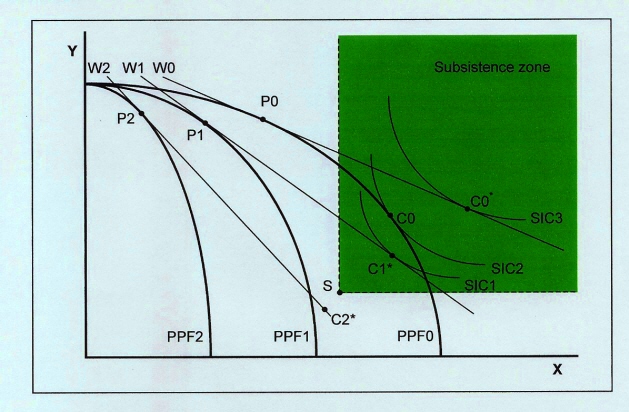
Consider a poor country producing and consuming two goods X and Y, where X represents all those agricultural goods whose production may be affected by climate change, and Y represents all other goods.  In the diagram below (2), PPF0 is the initial production possibility frontier. Point S represents the minimum consumption quantities necessary for subsistence of the country’s population.  Within the ‘subsistence zone’ above and to the right of S, social indifference curves SIC represent successively higher levels of welfare above the subsistence minimum.

Since PPF0 passes through the subsistence zone, the country could initially subsist without trade, producing and consuming at point C0 where PPF0 touches the highest available indifference curve SIC2.  If however it is able to trade, importing X and exporting Y on terms indicated by the slope of the world price line W0,  it can produce at P0 but consume at C0*, achieving the higher welfare level SIC3 (an example of the gains from trade).  This is important in the context that climate change and its effects are hard to predict with accuracy.  Many approaches to mitigation and adaptation involve the certainty of incurring substantial costs but great uncertainty as to the benefits.  By contrast, open trading involves little cost and yields benefits even if production is unaffected by climate change.

Now suppose that due to climate change the production possibility frontier contracts to PPF1,   passing to the left of S.  The country can no longer subsist solely on the basis of its own production.  If however it can trade on terms indicated by W1,  it can produce at P1 but consume at C1*.  In this case the gains from trade make the difference between destitution and subsistence. There is also a double benefit to other countries: not only imports of Y, but also avoidance of the migration and instability likely to result where a country cannot provide its people with a subsistence minimum.

As the diagram is drawn, W1 slopes down more steeply than W0, implying that lower productivity in X is accompanied by a worsening of the terms of trade.  This pessimistic assumption is plausible since climate change may also reduce production of X in other countries, raising the world price of X (and increased supply of Y may depress the world price of Y).  It is also possible, more optimistically, that climate change could increase production of X in some other countries (making it possible to grow wheat in more northerly regions of Canada and Russia, for example).   However, the case for trade as a means of adaptation does not rest on any such assumption (although if this were so the gains from trade would be magnified).

Given the even more severe scenario represented by production possibility frontier PPF2 and terms of trade W2, it would no longer be possible, even with trade, for the country to achieve subsistence.  Nevertheless, the gains from trade could still make a substantial contribution, enabling the country to consume at say C2*, much closer to S than PPF2, leaving a much smaller gap to be bridged by foreign aid or other means.

There is much that this analysis leaves out.  A country’s production possibility frontier may expand over time with investment and innovation.  Its subsistence zone may shift with population growth.  Its terms of trade may fluctuate.  Notwithstanding such considerations, the gains from trade ensure that a country will be better placed to cope with reduced agricultural production due to climate change if it participates in an open trading system.

Notes and References

  1. The Stern Review: Executive Summary (2006) p xxv.  Available at:  http://webarchive.nationalarchives.gov.uk/+/http:/www.hm-treasury.gov.uk/sternreview_index.htm
  2. The diagram is based on a standard general equilibrium analysis of the gains from trade, as for example in Koo W W & Kennedy P L (2005) International Trade and Agriculture  Blackwell  pp 38-39.  The new features here are a) defining the two representative goods in terms of whether their production is affected by climate change, and b) inclusion of the subsistence zone.
Posted in Climate change | Tagged , | Leave a comment

Groundwater – the Essentials

Everyone is familiar with water in the form of rain, rivers, lakes and seas.  But  groundwater is less well-known.  Here are the essentials, in Question and Answer form.

What is groundwater?
Underground water in saturated layers of porous rock or sand known as aquifers (1).

How does it get there?
Mainly by infiltration of rainwater through soil and porous rock. Eventually the water reaches a layer of non-porous rock, above which it accumulates.

Does groundwater remain there forever in the absence of human intervention?
Many aquifers are recharged by rainwater, and discharge water through springs or seeps when the water table (ie level) is high, resulting in a gradual turnover of the water they contain (1).  However, some aquifers in arid countries such as Libya contain water that has been undisturbed for thousands of years (2).

How much groundwater is there worldwide?
Roughly a hundred times as much as all the water in surface rivers and lakes (3).

How is it extracted?
Usually by drilling a borehole and installing a tubewell, a long narrow tube often made of PVC.  Water is then lifted by a manual, electric, diesel or solar-powered pump (5, 6).

How is it used?
Agriculture is the largest use globally. Groundwater is also widely used for domestic water supply (7).

Which countries extract the most groundwater?
India (25%), followed by China and the US (10% each) (7).

How much groundwater is extracted worldwide?
About 1,000 cubic kilometres annually, or 25% of all water withdrawn for human use (the rest being mainly from surface rivers and lakes). The amount is growing fairly rapidly (7).

Is this sustainable?
This is complicated.  Groundwater that is regularly recharged by rainfall is a renewable resource, and the relevant comparison is between annual extraction and annual recharge.  Where it is not recharged, no rate of extraction can be sustained indefinitely, and the question then is how long the groundwater reserves will last.  Worldwide, annual extraction is about 10% of annual recharge and about 0.0001% of total reserves (7).  However, some groundwater is too deep to be accessible, some is polluted, and our knowledge is incomplete.  The global totals appear sustainable in the short term, but the longer-term position is unclear.

Aren’t water tables already falling rapidly in some parts of the world?
Yes.  There is a geographical mismatch between demand for and availability of groundwater,  resulting in depletion of aquifers in some regions such as parts of India and Pakistan (8).  Where aquifers extend under land occupied by many farmers, with no property rights over the groundwater or regulation of extraction, there can be a form of ‘tragedy of the commons’.  As water tables fall, deeper tubewells are needed to extract water, pumping costs increase, and  pollutants can become more concentrated.  However, much groundwater is under-exploited, especially in South America, Sub-Saharan Africa and Indonesia (8).

Why might a farmer in an area with high rainfall and/or a surface irrigation network choose to invest in a tubewell?
Key factors are flexibility and reliability (9). Rainfall may be variable or seasonal. Water delivery from large surface irrigation systems is often unreliable due to seasonal factors, poor maintenance, or control of allocation by local elites. A tubewell can provide a year-round flexible supply, independent of any other party.  Where rainfall is seasonal, groundwater may support a second crop.  A more reliable water supply can also enable a farmer to switch to higher-value crops that because of their water requirements would otherwise be too risky (9).

How serious a problem is groundwater pollution?
Pollutants can accumulate in aquifers where there are regular inflows from agricultural drainage, urban wastewater or landfill sites.  Groundwater may also contain natural contaminants such as arsenic or radon gas (10).  However, water volumes in deep aquifers are often so large that concentrations remain low. Much groundwater is considered safe for human consumption (11). Shallow groundwater is more likely to be unsafe.  There have been widespread health problems from drinking unsafe groundwater in Bangladesh (12) and China (13).

What about pollution and agricultural use?
Salination of groundwater is a widespread problem (14).  Crops irrigated with saline water may suffer from reduced yields, and very saline water may be unuseable.  There is also a risk that pollutants in water may be absorbed by crops and enter the human food chain.  This is hard to evaluate since effects may be long-term and dependent on quantities consumed.  Concerns to date in this respect have centred more on urban wastewater than on groundwater (14).

Notes & References

1.  McGinley M (2011) Aquifer, in Encyclopaedia of Earth http://www.eoearth.org/article/Aquifer

  1. FAO Aquastat: Libya (Version May 2006)   http://www.fao.org/nr/water/aquastat/countries_regions/libya/index.stm

3.  Water in rivers and lakes is about 0.13 million cubic kilometres (4). Global groundwater reserves are estimated at between 7 and 23 million cubic kilometres (7).

  1. Townsend C, Begon M & Harper J (3rd edn 2008) Essentials of Ecology  Blackwell Publishing  p 380
  2. Water Aid,  Tubewells and Boreholes   http://www.wateraid.org/uk/what_we_do/sustainable_technologies/technology_notes/243.asp
  3. WHO, Factsheet 2.3 Boreholes and Tubewells   http://www.who.int/water_sanitation_health/hygiene/emergencies/fs2_3.pdf

7.  Comprehensive Assessment of Water Management in Agriculture 2007  Water for Food, Water for Life: A Comprehensive Assessment of Water Management in Agriculture  London: Earthscan, and Colombo: International Water Management Institute  p 398-9

8.  Comprehensive Assessment as above, p 402-3

9.  Comprehensive Assessment as above, p 409-11

  1. Water Encyclopaedia: Pollution of Groundwater   http://www.waterencyclopedia.com/Oc-Po/Pollution-of-Groundwater.html
  2. US Environmental Protection Agency  Drinking Water from Household Wells  pp 2-3   http://www.epa.gov/privatewells/pdfs/household_wells.pdf
  3. WHO  Arsenic in Drinking Water   http://www.who.int/water_sanitation_health/dwq/arsenic/en/
  4. People’s Daily Online, Nov 5 2010: Most Northern Plain Groundwater Unsafe to Drink   http://english.peopledaily.com.cn/90001/90776/90882/7188979.html
  5. Comprehensive Assessment as above, p 432-4
Posted in Agriculture, Water | Tagged , , , | Leave a comment

Puma’s Environmental P&L

Puma, a sportswear company, has created a stir with its ‘environmental profit and loss’ (EPL) account.  It is a praiseworthy initiative, but the results should be used with care.

Environmental reporting by companies is not new.   Puma’s innovation is to place monetary values on its environmental impacts, enabling them to be compared and summed.  It estimates the net loss of welfare due to its environmental impacts in 2010 at EUR 145M, the main contributors being greenhouse gas emissions (EUR 47M), water use (EUR 47M) and land conversion (EUR 37M).  Much of the impact is well down its supply chain in the production of raw materials such as cotton and leather (1).

‘Environmental profit and loss’ is a catchy name that may have helped Puma gain publicity, but it could mislead.  The reported environmental impacts are virtually all negative, the only ‘profit’ relating to energy recovered from waste incineration (2).  ‘Profit and loss’ suggests that what Puma has done is accounting when it is really economics.  The crucial step of placing monetary values on various physical units relies heavily on the economic literature on environmental valuation, notably a review by Tol (3) of the economics of climate change, and The Economics of Ecosystems and Biodiversity (TEEB) (4).  A more accurate term for what Puma has measured would be ‘net external environmental cost’.

What can be done with these figures?  Some uses Puma suggests (5) are:

  • To indicate where its efforts to reduce environmental impacts can best be directed.
  • To identify environmental issues that pose emerging risks to shareholder value.
  • To increase transparency to stakeholders regarding the company’s environmental impacts.
  • To assist employees in taking account of environmental impacts in day to day business decisions.

These are all valid points.  One caveat however is the importance of equity as well as overall scale in evaluating environmental impacts.  Any impacts that threaten livelihoods, even of small groups, need to be taken particularly seriously.  Another is the dependence of the figures on the particular economic valuation techniques used and assumptions made.  For example, the value placed on water use relates only to indirect effects on ecosystem services.  It is assumed that the direct reduction in water availability for consumption by others is already reflected in the price paid for the water (6).  This is questionable, since in many parts of the world water is priced well below its full cost (7).

Another use that might be attempted is this.  Profit as conventionally measured is not a good measure of a company’s net contribution to welfare, so why not try to improve it by making a deduction for environmental externalities?  One might observe that if Puma’s EPL cost (EUR 145M) is deducted from its accounting profit (EUR 301M in 2010 (8)), the result is still a net profit (EUR 156M).  This is I think slightly reassuring: imagine the outcry if environmental impacts had been much larger than accounting profits.

However, it would be wrong to place too much weight on such a figure, since it is a hybrid based partly on accounting and partly on economics.   Externalities are just one welfare-related issue recognised by economics but not by conventional accounting.  Others are:

  • consumer surplus: the welfare implicit in the difference between the maximum price consumers would be willing to pay and the price they actually pay;
  • opportunity cost: the value of resources to society in their best alternative use;
  • the need to adjust prices paid for market distortions such as indirect taxes and over-valued exchange rates.

A proper measure of a company’s net contribution to welfare would require a kind of cost-benefit analysis allowing for all these issues, albeit with its scope the entire operations of a company and its supply chain, rather than a particular project.  What a company could perhaps do is prepare conventional accounts for accountability to shareholders together with a cost-benefit analysis for accountability to society (and to identify risks to shareholder value).  One part of such an analysis would be to value its environmental impacts, and this would require just the sort of assessment that Puma has done.

Notes and References

  1. Puma (2011) Environmental Profit and Loss Account 2010 p 6 & 8.      http://about.puma.com/wp-content/themes/aboutPUMA_theme/financial-report/pdf/EPL080212final.pdf

2.   Puma, as above p 22

3.   Tol R. (2009), “The Economic Effects of Climate Change” Journal of Economic Perspectives Vol 23 : (2)     http://www.aeaweb.org/issue.php?journal=JEP&volume=23&issue=2

4.   TEEB (2010) The Economics of Ecosystems and Biodiversity: Mainstreaming the Economics of Nature: A synthesis of the approach, conclusions and recommendations of TEEB.    http://www.teebweb.org/TEEBSynthesisReport/tabid/29410/Default.aspx

5.   Puma, as above pp 4-5

6.   Puma, as above p 17

7.  Comprehensive Assessment of Water Management in Agriculture (2007)  Water for Food, Water for Life: A Comprehensive Assessment of Water Management in Agriculture  London: Earthscan, and Colombo: International Water Management Institute  p 378

8.  Puma (2011) Annual Report 2010 p 137. EUR 301M is the pre-tax profit, described as Financial Result.      http://ir2.flife.de/data/puma/igb_html/index.php?bericht_id=1000004&index=&lang=ENG

Posted in Environment (general) | Tagged , , | Leave a comment