A Fallacy about Trade

What determines the production quantities and relative prices of internationally-traded goods?  Some textbooks suggest a misleading answer.

An old textbook I have on my shelves (Wells 1969 (1)) has a diagram similar to Diagram 1 below, showing the production possibility frontiers of two countries A and B producing two goods X and Y.  The book suggests by the way the diagram is drawn that under free trade the ratio of the price of X to the price of Y is represented by the common tangent (shown in red). Consequently the points of tangency, PA and PB, represent the combinations of goods produced by each country.Trade Fallacy Diagram 1

This method of finding the free trade price ratio cannot be generally correct.  Here are two reasons:

  1. Suppose country B is small, so that its production frontier is PPFB*, lying entirely within PPFA.  Then the method cannot be applied since it is impossible to draw a straight line tangential to both PPFA and PPFB*.  Given free trade, however, A and B will still engage in trade, provided only that their respective price ratios in the absence of trade are different, creating scope for gains from trade.
  2. Suppose consumers in both countries have a strong preference for X over Y, implying near-vertical social indifference curves.  Then the method leads to wrong conclusions since production in that case will not be at PA and PB.  It will be approximately at QA and QB, with both countries producing close to their maximum possible quantity of X.

This may seem to be labouring an obvious point.  But perhaps it isn’t so obvious, since a modern textbook (Koo & Kennedy 2005 (2)) uses a similar diagram (with some additions), identifying the production quantities under trade equilibrium as the equivalent of PA and PB in Diagram 1.  This is surprising since, only a few pages before, Koo & Kennedy give a correct explanation of the determination of the free trade price ratio in the 2-country 2-good case (3).  Given each country’s production frontier and social indifference curves, this involves constructing a diagram showing their respective offer curves.  The point of intersection of the offer curves then indicates the equilibrium import / export quantities and the price ratio.

It then remains to find the associated production quantities.  One way is to apply the free trade price ratio to a diagram showing the production frontiers.  The point that is perhaps easy to miss is that one cannot in general draw a line of given slope that is tangent to both the production frontiers.  In general two parallel lines must be shown, one for each country.  It is the slope of a line, not its position, that represents a price ratio, so parallel lines represent the same price ratio.  Diagram 2 shows how this works for the case of the large and small country.Trade Fallacy Diagram 2

R shows the slope of the price ratio, assumed to be inferred from an offer curve diagram.  To find A’s production quantities, we find the point PA on its production frontier at which the tangent, RA, is parallel to R.  Similarly B will produce at point PB on its production frontier, at which the tangent RB is parallel to R.  Given A’s import and export quantities from the offer curve diagram, we can also find the point CA on RA representing A’s consumption quantities.  Similarly we can find point CB on PB representing B’s consumption quantities.

A geometric proposition that is generally valid, whether or not the production frontiers overlap, is that the four production and consumption points (PA, PB, CA, CB) form the corners of a parallelogram.  But for the two tangents to coincide, as in Diagram 1, so that all four points lie in a straight line, would just be a coincidence.  It looks neat but has no economic significance.

Notes and References

1. Wells S J (1969)  International Economics  George Allen & Unwin, London  p 42

2. Koo W W & Kennedy P L (2005)  International Trade and Agriculture  Blackwell Publishing  pp 50-51

3. Koo & Kennedy, as above  pp 41-43
Posted in Trade | Tagged , , | Leave a comment

Lessons from the Industrial Revolution

The economics of energy in the 18th century offers lessons for the present.

I recently read Robert Allen’s The British Industrial Revolution in Global Perspective (1), a fascinating analysis of why the industrial revolution happened, why it happened in Britain, and why other countries industrialized only later.  Had I been asked beforehand for answers to these questions, I might have listed the following features of 18th century Britain:

  1. Large and accessible coal deposits.
  2. Ingenuity of its inventors, exploiting the scientific knowledge of the enlightenment.
  3. Relatively good governance by the standards of the time.
  4. Rural land reform (enclosure) facilitating higher food production to support growing cities.

According to Allen, however, 1 and 2 were not unique to Britain, and 3 and 4 are dubious.  His analysis focuses instead on relative prices.  And his main conclusion is this: in 18th century Britain, a combination of relatively high wages and cheap energy from coal made it profitable to substitute steam power for labour, even though the steam engines of the time were very inefficient (2).  Allen presents detailed evidence showing that the wages of labourers in 18th century Britain were much higher than those in most of Europe, India and China, and comparable only with those in the Netherlands and parts of North America (3).   Only Britain had significantly exploited coal at that time, and the price of energy in British coalfield regions was the lowest in the world.

How had this situation come about?  The reasons are complex and Allen’s explanation goes back several centuries (4).  Prominent in his account are: Britain’s success in exporting woollen cloth, supported by improvements in sheep farming; its economic gains from mercantilism and empire; the growth of London beyond the point at which its energy needs could be met at reasonable transport cost by wood; the development (via what Allen terms ‘collective invention’ by London builders) of houses designed to be heated by coal; and the consequent stimulation of coal mining around Newcastle, from where London was supplied by ship.

The development of steam power was financed by businesses and entrepreneurs. Innovation was facilitated by business clusters such as tin mines in Cornwall (another case of collective invention).  The power obtained from steam engines per ton of coal increased tenfold between 1730 and 1850 (5).  Steam power became profitable at progressively lower wage / coal-price ratios, and around 1850 was rapidly adopted in other European countries and the US.  These countries had not been without coal deposits, inventors or entrepreneurs, but profitability at their prices determined the timing of adoption. Since moreover they were able to adopt the latest and most efficient technology, they did not need to waste resources repeating Britain’s long experimentation with early steam engines.

Allen’s book is a work of economic history, and does not attempt to draw lessons for the present.  It does however offer much material suggestive of present-day parallels.

In most developed countries today, labour and energy costs are both high (taking costs to include the social costs of pollution and climate change associated with fossil fuels).  A resource that is cheap by historic standards is information and communication technology (ICT).  Developments such as smart meters and smart electricity grids can be viewed as attempts to substitute that cheap resource for high-cost labour and energy.  Whether the energy cost savings from these developments can be more than marginal is debatable.  But the application of ICT directly to energy supply is only one way to use it to reduce energy costs.    Take electronic books, for example.  They do not just reduce the cost of books by saving on physical material costs.  They also facilitate space-saving wherever buildings contain shelves of books, and that saving in space could permit smaller buildings requiring less energy to heat.

Blue-sky thinking suggests other ways in which ICT might be harnessed to save energy. Driverless freight vehicles could not only reduce labour costs but also, by avoiding the need to transport drivers as well as goods, reduce weight and therefore fuel costs.  Automated kitchens could save energy by selecting the most energy-efficient method to cook any dish, heating the minimum quantity of water for boiling or steaming, and facilitating more enclosed cookware with less heat loss.  Kitchen automation could be linked to just-in-time delivery systems from food suppliers, reducing the need for homes to keep large stocks of food in energy-hungry and space-occupying fridges and freezers.  Just as in early modern times the home was re-designed, replacing a central wood-burning fire with fireplaces and chimneys designed for coal, so perhaps homes now need to be re-designed for energy efficiency.  The home of the future could be smaller but much more functional, with sophisticated systems managing any processes that use energy.

Another parallel relates to the development of renewable energy.  The example of steam power suggests that the most promising route is for countries to specialise in the development of those types of renewables that are or could soon be profitable in their particular circumstances. That probably means solar power in hot dry countries, biofuels in tropical countries with suitable soil and rainfall, and wind power in countries with fairly steady winds. Such specialisation reduces the need for investment to be subsidised by government, and increases opportunities for collective invention.  Countries in which a particular energy source is only available at high cost (such as solar power in northern Europe) might do best to ignore that source until development elsewhere has improved efficiency and reduced costs, just as many countries in the 18th century ignored steam power because for them it was too expensive.

Notes and References

  1. Allen R C (2009) The British Industrial Revolution in Global Perspective  Cambridge University Press  331pp
  2. Allen pp 138-40 & 156-7
  3. Allen Chapter 2
  4. Allen Chapters 4 & 5
  5. Allen p 165
Posted in Energy | Tagged , , , , , | Leave a comment

Some Economics of a Carbon Tax

A carbon tax can be an effective policy for reducing emissions.  It also affects output and social welfare.

Like many economists I am fond of diagrams.  I feel I understand a piece of economics when I see it expressed in a diagram.  Here I present two diagrams that can help in understanding the effects of a carbon tax.

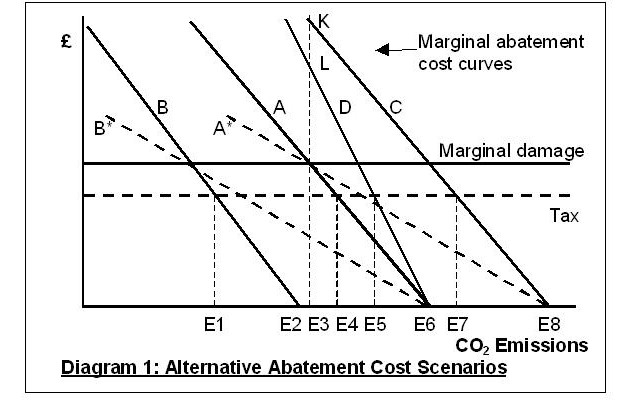
Diagram 1 assists in comparing a marketable permit system (cap-and-trade) and a carbon tax, focussing on their performance under uncertainty.  The marginal damage curve is horizontal because atmospheric CO2 is a long-term cumulative pollutant, whereas the diagram is assumed to relate to a short period such as a year.

Carbon Tax Diagram 1Suppose the marginal abatement cost curve is expected to be A, and a cap-and-trade policy caps emissions at E3, where marginal abatement cost is expected to equal marginal damage.  This is expected to reduce emissions at moderate cost from E6 to E3.  Suppose however there is an unforeseen recession so that emissions fall anyway to E2, and the actual marginal abatement cost curve is B.  In that case the cap at E3 has no effect, and the carbon price falls to zero, removing any incentive for abatement (as occurred in the EU Emissions Trading System with the onset of recession in 2007 (1)).  Other possible scenarios are higher than expected economic activity (curve C) or more steeply rising marginal abatement costs (curve D).  In these cases the cap at E3 is effective in reducing emissions, but the costs at the margin are high (K and L respectively).

Now consider the effect of a carbon tax.  Make the worst-case (but realistic) assumption that we cannot accurately estimate marginal damage, so that the tax rate is liable to be somewhat more or (as in the diagram) less than marginal damage.  Such a tax will at least provide a stable incentive yielding a worthwhile reduction in emissions at moderate cost under any of the above scenarios.  If the marginal abatement cost curve is A, then tax at the rate shown will reduce emissions from E6 to E4.  If it is B, then emissions will be reduced from E2 to E1.  For C and D, the reductions are from E8 to E7 and E6 to E5 respectively.

The above is perhaps the main economic reason for preferring a carbon tax to cap and trade.  However, the slope of the marginal abatement cost curve is important in two ways.  If the slope is shallow, the case against cap-and-trade is weakened (if the expected curve were A* but due to recession the actual curve were B*, a cap at E3 would still yield some reduction in emissions).  If the slope is almost vertical, then the reduction in emissions from any moderate tax rate would be small.  The case for a carbon tax is strongest when the marginal abatement cost curve is steep but not too steep.

What are the effects of a carbon tax and the abatement it induces on an economy as a whole?  The tax itself is simply a transfer from firms to the government, and its effects will depend on related circumstances, such as whether there is an offsetting adjustment to other taxes.  The cost of the induced abatement, however, is a real economic cost.  In general, abatement may be achieved either by reducing emissions per unit of output, or by reducing output (2).  Hence we should expect abatement costs to firms to comprise both technical costs of reducing emissions per unit of output and lost sales income due to reduced output, the profit-maximising combination for any firm depending on its particular technology and market position.

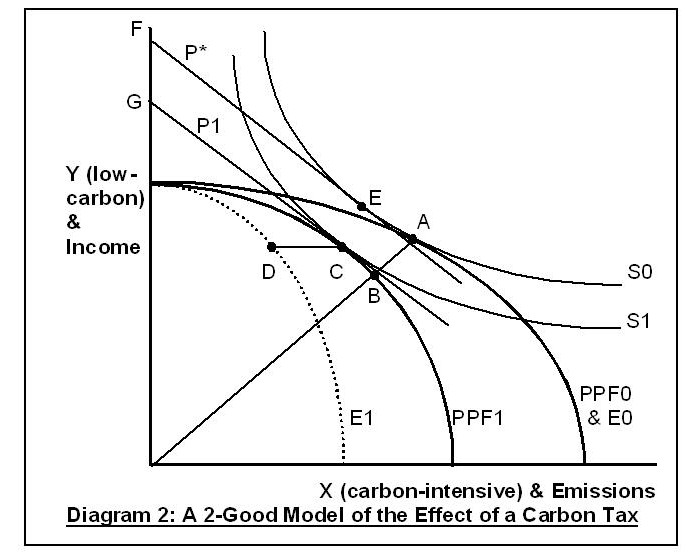
Diagram 2 helps to understand the effect on an economy as a whole of firms adjusting their technology and output in response to a carbon tax (for an analysis at firm level showing that they would adjust both technology and output see this post).  It shows combinations of X, representative of goods whose production is carbon-intensive, and Y, representative of low-carbon goods.  Initially, with no emissions reduction policy, the production possibility frontier is PPF0.  The horizontal dimension is also used to represent emissions, on a scale such that PPF0 also shows the corresponding initial levels of emissions E0.  Given a carbon tax, firms would produce somewhat less X, and would produce it with lower per-unit emissions by marginally different techniques requiring additional inputs with an opportunity cost in terms of alternative productive use.   Hence the production possibility frontier PPF1 would be to the left of PPF0, and the emissions curve E1 even further to the left.

Carbon Tax Diagram 2Given social indifference curves Sn as shown, and assuming a perfectly competitive economy, the initial equilibrium is at A where PPF0 touches S0.    If the post-tax output proportions were unchanged, production would shift to B.  However, only by chance will B be the new equilibrium.  As the diagram is drawn, the new equilibrium is at C where PPF1 touches S1, implying that demand for X is moderately elastic.  Point D represents the emissions corresponding to C, and the horizontal distance between A and D represents the overall reduction in emissions.

This reduction is achieved at the cost of a welfare reduction from S0 to S1.  This can be quantified in terms of Y as the compensating variation (3) by adding budget lines P1 and P*, where P1 is tangential to S1 at C, and P* is parallel to P1 and tangential to S0 (at E).  The cost in terms of Y is therefore distance FG.

Diagram 2 admittedly cannot handle radical change from carbon-intensive to low-carbon methods, such as a switch from coal to renewables for generating electricity.  Nor does it show technical progress which, on an optimistic scenario, might expand the production possibility frontier without adding to emissions.  What it does show, however, is that the cost to society of reducing emissions is a complex matter depending upon, among other things, the elasticity of demand for carbon-intensive goods.

As an example of the relevance of elasticity, consider air travel. One person may be willing to forgo a large quantity of other goods for the sake of fast air travel. Another may enjoy the experience of alternative, lower-carbon modes of travel or be more willing to travel less frequently.  If most people are like the former, then the cost to society of reducing emissions will be greater, other things equal, than if most are like the latter.

Addendum 8 February 2014
This post has been significantly edited. The original version conveyed the erroneous impression that the analysis in Diagram 2 helped to explain the slope of the marginal abatement cost in Diagram 1.  This impression has now been removed.

Notes and References

  1. Tilford S, Centre for European Reform (2009) Carbon price collapse threatens the EU’s climate agenda  http://www.cer.org.uk/publications/archive/bulletin-article/2009/carbon-price-collapse-threatens-eus-climate-agenda
  2. Common M & Stagl S (2005) Ecological Economics: An Introduction Cambridge University Press  p 415
  3. For an explanation of compensating variation as a general measure of the welfare effect of a movement between indifference curves (rather than a specific measure relating to a price change) see Wainwright, K, CV & EV, Measuring Welfare Effects of an Economic Change at http://www.sfu.ca/~wainwrig/Econ200/documents/cv-ev-notes.pdf  There is no particular reason here to use compensating variation to measure the welfare change rather than the alternative equivalent variation measure.
Posted in Climate change | Tagged , , | Leave a comment

The Role of Contingent Valuation

Contingent valuation is sometimes presented as applicable to any environmental good, unlike other valuation methods which can be used only in particular circumstances.  Recent thinking suggests a narrower role.

A symposium in the Journal of Economic Perspectives (1) offers three views of contingent valuation, a widely-used method for valuing non-market environmental goods.  Richard Carson argues in favour and Jerry Hausman against, while Catherine Kling and her co-authors take a more nuanced position.  A careful reading, however, suggests much common ground.

Contingent valuation is often criticised as subject to hypothetical bias, that is, when people are asked how much they would pay to help conserve an environmental good, their responses tend to overstate their true willingness to pay.  This can be tested where willingness to pay can be measured directly, and all three papers accept that many studies have found upward bias in such situations.  For Hausman, such findings support his general criticism of contingent valuation, but Carson and Kling argue that they are of little relevance.

Central to Carson’s and Kling’s position are the concepts of consequentiality and incentive-compatibility.  A question about an environmental good is consequential if respondents care about the good and believe that their responses may influence the actions of an agency towards the good.  Where a question is consequential, people’s responses can be viewed as a form of economic behaviour, revealing something about their preferences. A survey question is incentive-compatible if a truthful response is an optimal strategy for respondents who perceive the question to be consequential.  Questions may use a variety of elicitation formats (open question, binary choice, multinomial choice, etc), and Carson and others have explored which are incentive-compatible and which are not (2).

Carson and Kling argue that good contingent valuation studies are consequential and incentive-compatible, whereas findings of hypothetical bias relate to studies that fail to meet those conditions (3).   They accept that studies which do not meet the conditions will not yield reliable valuations.  So all the authors agree that contingent valuation studies that do not meet the consequentiality and incentive-compatibility conditions will not give good results.  For Hausman this is because contingent valuation studies in general are subject to hypothetical bias (and other problems described in his paper).  For Carson and Kling it is because a study that does not meet the consequentiality and incentive-compatibility conditions is not a proper contingent valuation study, and is therefore subject to hypothetical bias.

How large is this common ground?  There is, I suggest, a large class of actual and potential contingent valuation studies that lack consequentiality.  Consequentiality surely depends in part on the circumstances surrounding a study, such as whether the government is considering a policy towards the good being valued, and will take account of the results of relevant studies in developing its policy?  A researcher can tailor a study to such circumstances if they exist, but is unlikely to be able to bring about such circumstances if they do not already exist.

This point is not clearly brought out in Carson’s paper because he uses forms of words that focus on communicating to respondents that their responses may influence policy, and on respondents understanding that that is so (4).  Communication and understanding are important, but what this seems to neglect is whether it is actually the case that the survey responses may influence policy.  Perhaps Carson takes this as read, as such an obvious presupposition of consequentiality as not to need stating.  Another interpretation, however, is as allowing the possibility of what might be termed a pseudo-consequential study, in which people are led to believe that their responses may influence policy when this is not actually the case.  It is perhaps not surprising, therefore, that Hausman (quoting Harrison) criticises proponents of contingent valuation as seeking ways to make people feel that their responses matter by tricking them into believing things that are not true (5).

If contingent valuation requires consequentiality, and not merely pseudo-consequentiality, then its scope for application differs in a fundamental way from that of other valuation methods.  A researcher can choose an interesting subject for, say, a travel cost study, and realistically expect that good research design, good data and sound analysis will lead to a reliable valuation.  But if a researcher chooses a subject for contingent valuation simply because it looks interesting, then the study is unlikely to be consequential and unlikely to yield reliable results, however carefully it is done.  Only if a contingent valuation of a good is commissioned by an agency whose actions may affect that good, or in a limited range of other circumstances, is it likely to be consequential and therefore to have the potential to give reliable results.

Notes and References

1.  Journal of Economic Perspectives, Vol 26 No 4, Fall 2012 including:  Kling C L, Phaneuf D J & Zhao J  From Exxon to BP:Has Some Number Become Better than No Number  pp 3-26;  Carson R T  Contingent Valuation: A Practical Alternative When Prices Aren’t Available  pp  27-42;  Hausman J  Contingent Valuation: From Dubious to Hopeless  pp 43-56.

2.  See especially Carson R T & Groves T (2007)  Incentive and Informational Properties of Preference Questions  Environmental and Resource Economics  37(1)  pp 181-210.

3.  Carson, in (1) above p 37.  Kling, in (1) above p 11.

4.  Carson, in (1) above p 30 (4 lines from bottom) and p 31 (line 7).

5.  Hausman, in (1) above p 45.

Posted in Environment (general) | Tagged , , , , | 2 Comments